
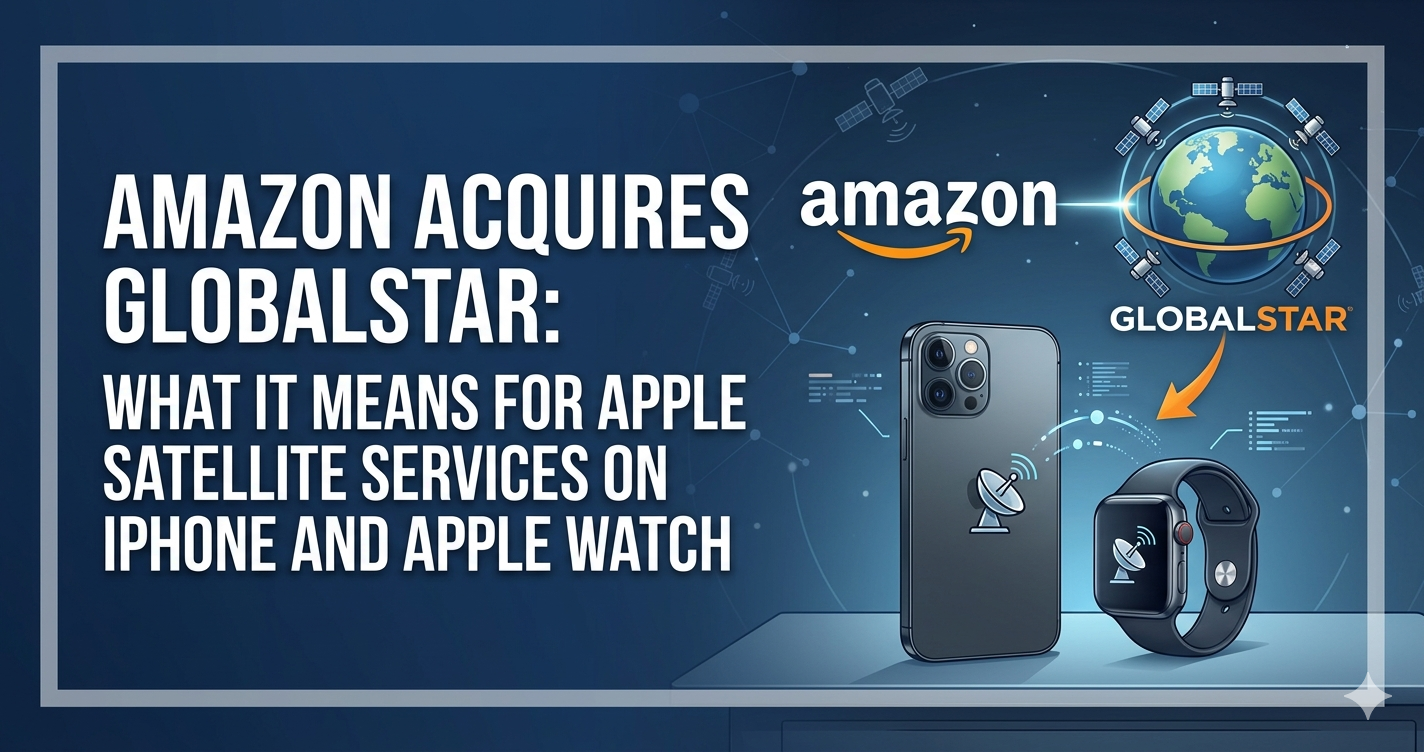
In one of the biggest technology deals of 2026, Amazon has acquired Globalstar — the satellite company that has powered Apple’s satellite services on iPhone and Apple Watch since 2022 — in an $11.57 billion transaction announced today. Alongside the acquisition, Amazon and Apple have struck a new agreement for Amazon Leo to power satellite services for iPhone and Apple Watch, including Emergency SOS via satellite, Messages, Find My, and Roadside Assistance.
The deal reshuffles the satellite connectivity landscape significantly, positioning Amazon as the backbone of Apple’s life-saving satellite features while simultaneously supercharging Amazon Leo’s ambitions to compete with Elon Musk’s Starlink.
What the Amazon Acquires Globalstar Deal Actually Means
To understand the significance of this deal, it helps to know what Globalstar has been doing behind the scenes.
Globalstar is known for powering Apple’s Emergency SOS feature — the satellite-based service that allows iPhone users to contact emergency services when they’re completely outside of cellular coverage. In 2024, Apple committed approximately $1.5 billion to Globalstar — a combination of prepayments for satellite services and a 20% equity stake — in exchange for the right to most of its network capacity.
Now Amazon has stepped in to acquire the entire company. Amazon is offering Globalstar shareholders either $90 in cash per share, or 0.32 shares of Amazon stock, with the deal expected to close in 2027. That represents a nearly 117% premium over Globalstar’s price from late October 2025, before Bloomberg first reported that the company was exploring a sale.
Apple’s Satellite Journey: From iPhone 14 to Amazon Leo
Apple’s satellite connectivity story began in 2022 with the iPhone 14. What started as a life-saving emergency feature has quietly grown into one of the most used off-grid tools in Apple’s ecosystem.
Here’s how it has evolved:
- 2022 — iPhone 14: Emergency SOS via satellite launched, allowing users to contact emergency services when outside cellular range
- 2023–2024: Extended to Roadside Assistance via satellite for mechanical breakdowns
- 2024–2025: Expanded to include satellite messaging with friends and family, and Find My location sharing
- Now: Globalstar currently partners with Apple to power satellite service on iPhone 14 or later, as well as Apple Watch Ultra 3, allowing users to text emergency services, message friends and family, request roadside assistance, and share their location.
Greg Joswiak, Apple’s Senior Vice President of Worldwide Product Marketing, spoke to the real-world impact of the service: “Since launching more than three years ago, our groundbreaking safety service Emergency SOS via satellite has helped save many lives around the world — from a scout troop stranded on a winter hike in British Columbia, to a woman who was airlifted to safety in Colorado after her car rolled down a 250-foot cliff.”
Why Amazon Wanted Globalstar
Amazon’s satellite ambitions through Amazon Leo have been building quietly for years. Over the past year, Amazon launched roughly 200 LEO satellites into space, aiming to eventually grow the fleet to 7,700 and debut its commercial internet service in late 2026. But SpaceX’s Starlink — with more than 10,000 satellites already in orbit and over 9 million users — holds a commanding lead.
Acquiring Globalstar gives Amazon Leo three critical assets it couldn’t easily build from scratch:
1. Licensed Spectrum
Globalstar holds licensed mobile-satellite spectrum — a scarce and tightly regulated asset that is difficult for newer entrants to obtain. Globalstar‘s globally harmonized spectrum portfolio (L/S-band, Band 53/n53, and C-band) will enable higher-capacity, more spectrum-efficient direct-to-device services than legacy systems.
2. An Operational Satellite Fleet
Globalstar currently operates about two dozen satellites in low Earth orbit and is in the middle of a major expansion, backed by Apple, that will grow the fleet to 54 satellites.
3. Apple as a Flagship Partner
Perhaps most valuable of all: Amazon isn’t just buying Globalstar — it’s inheriting Apple’s satellite roadmap. Having the world’s most valuable company as a committed customer is a powerful foundation for Amazon Leo’s commercial future.
What Changes for iPhone and Apple Watch Users?
For current iPhone and Apple Watch users, the answer — at least for now — is: nothing.
With the new Amazon-Apple agreement, Amazon will continue to support iPhone and Apple Watch models currently using Globalstar’s existing and planned upcoming low Earth orbit satellite constellations, being manufactured by MDA Space, and collaborate with Apple on future satellite services using Amazon Leo’s expanded satellite network.
Apple has confirmed it is looking forward to the new partnership. “Apple and Amazon have a long and proven track record of working together through Amazon’s core infrastructure services, and we look forward to building on that collaboration with Amazon Leo,” said Joswiak.
The features you rely on — Emergency SOS, Messages, Find My, and Roadside Assistance via satellite — will all continue to function as normal.
What the Future Could Look Like
The deal promises more than continuity — it promises acceleration. By combining Amazon Leo’s scale and engineering with Globalstar’s spectrum and infrastructure, the two companies are positioning themselves to dramatically expand the reach and capability of satellite-powered connectivity.
The acquisition enables faster deployment of direct-to-device connectivity at scale — reaching areas where terrestrial deployment is delayed, cost-prohibitive, or vulnerable to disruption.
For iPhone users, that could mean broader geographic coverage for satellite features, faster response times, and new capabilities that go beyond the current emergency and messaging use cases. For Amazon, it means a credible path to competing with Starlink on the direct-to-device front — with Apple’s ecosystem as proof of concept.
Amazon vs. Starlink: The Battle for the Sky
This deal is impossible to discuss without acknowledging the elephant in the room: Elon Musk’s Starlink. SpaceX has a commanding lead in low Earth orbit satellite internet, and Amazon Leo has been seen as the most credible challenger to that dominance.
By acquiring Globalstar’s spectrum, infrastructure, and Apple partnership in a single move, Amazon has meaningfully closed the gap. Direct-to-device satellite service — the ability to connect smartphones directly to satellites without special hardware — is widely seen as the next frontier of mobile connectivity. Amazon now has the pieces to compete seriously in that space.
Key Deal Facts at a Glance
| Detail | Info |
|---|---|
| Acquirer | Amazon (Amazon Leo) |
| Target | Globalstar, Inc. |
| Deal Value | $11.57 billion |
| Per Share | $90 cash or 0.321 Amazon shares |
| Expected Close | 2027 |
| Apple’s Stake | 20% (now acquired by Amazon) |
| Services Covered | Emergency SOS, Messages, Find My, Roadside Assistance |
| Devices Supported | iPhone 14 and later, Apple Watch Ultra 3 |
Bottom Line
The Amazon-Globalstar acquisition is a landmark moment for the satellite connectivity industry. For Apple users, it means the safety features they’ve come to rely on are in safe — and arguably stronger — hands. For Amazon, it’s a bold move that instantly elevates Amazon Leo from an ambitious project to a credible, well-resourced competitor in the satellite era.
The deal is expected to close in 2027. In the meantime, your iPhone’s Emergency SOS via satellite works exactly as it always has — and its future just got a whole lot more ambitious.